Assignment 1 Sidibe and Mali Photography Show
How
does Sidibé imply motion or movement in his portraits?

Sidibe seems to utilize color, patterns, a lot of textiles
and textures, as well as the posing and positioning of his models/subjects in
order to convey a sense of movement and motion in his images. He seems to have mastered the art of the 'candid shot', catching his subjects either unsuspectingly, or in the middle of a dance move, or some action that tends to look a little absurd on camera.
What
does Sidibé say about the reason to take photos in regard to the passage of
time?
Sidibe says that taking a photo is like taking a snapshot
of that moment in time, it essentially captures, or freezes that instance or
moment into eternity.
Find
one photograph by Sidibé to discuss.
Write a paragraph or so about the photograph.
Danse le Twist, 1965. Gelatin silver print
I chose this image
because it felt reminiscent of the images I have recently discovered taken in
Seattle around the same time (mid sixties) by Seattle photographer, Al Smith. I
realized how similar the activities and images seem to be, the black
communities of Seattle and Mali seem to both be united in dance and
celebration! It is incredible to see the similarity among people in a similar time,
still finding joy and happiness even amidst trying and transitioning times,
regardless of the place that they are occupying/calling home.
What
is real about Sidibé's photography? What
is symbolic?
The most ‘real’ thing about Sidibe’s photography, to me,
seems to be his choice of subject/model. He doesn’t seem to regularly work with
subjects who have a known or established identity. He doesn’t seem to care
whether or not the person in his photograph has money, power, or anything in
particular rather than a willingness to be photographed and/or posed. I think
that is the most symbolic thing about his work as well, because it is
equalizing the playing field, in a sense, for people to become part of and
involved with photography and modeling on a casual and accessible level,
instead of perpetuating the notion that photography requires money, or modeling
is about fame.
Visit
the NPR website for this article about a recent show at the Mali National
Museum. Choose one photograph to discuss. https://www.npr.org/sections/goatsandsoda/2018/01/28/579767293/photos-shaking-up-the-idea-of-what-africa-looks-like
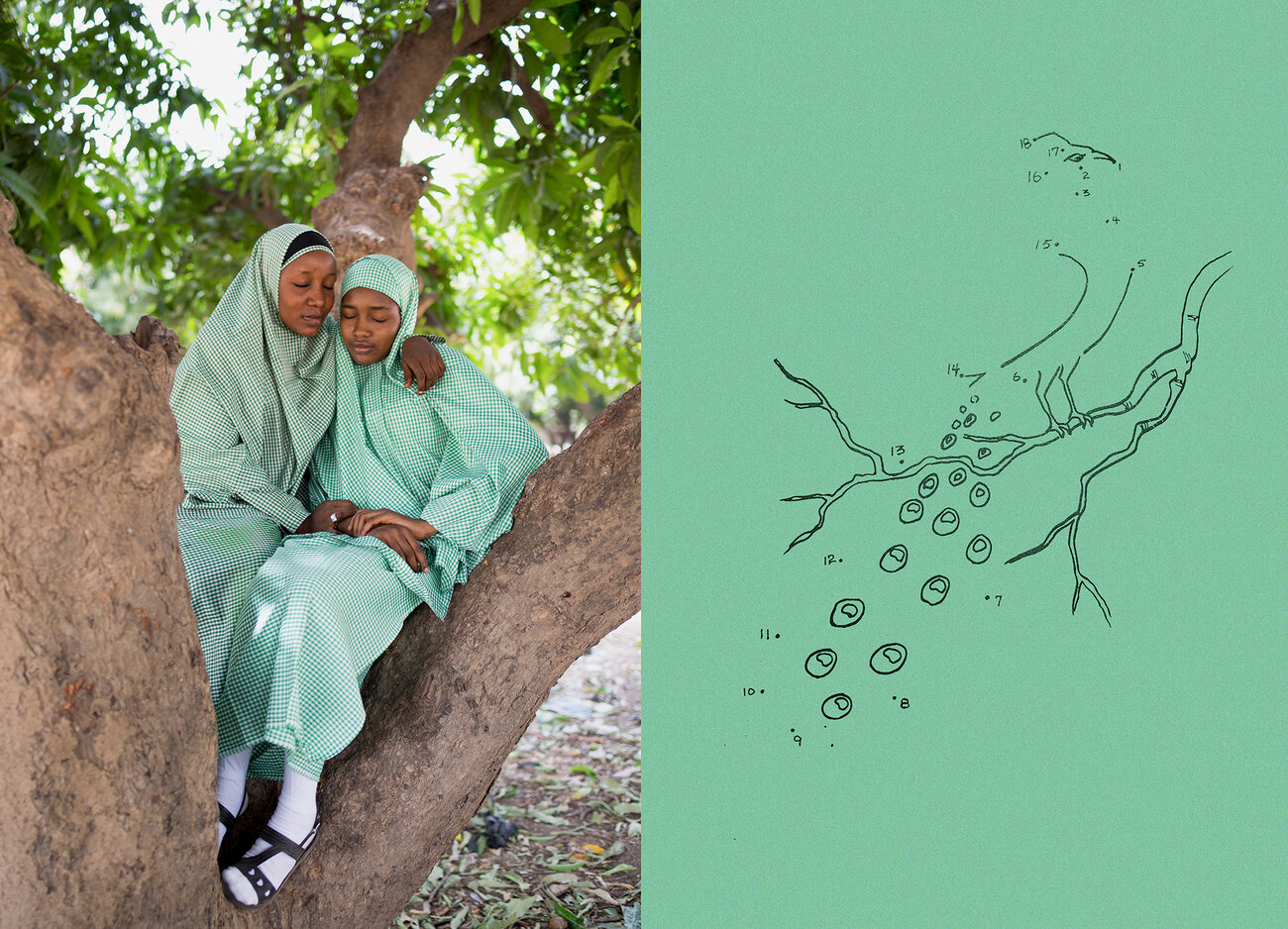
Education is Forbidden, 2015, Nigeria.
Rahima Gambo
I chose this photograph because I love the juxtaposition of
the illustration with the photograph. The color scheme is very soothing and
calming, and the emotions and presence of the models in the photograph also
portray a very calm feeling. It also looks as though they may be comforting
each other. I like that the illustration is a connect the dots drawing, because
it made me more conscious of how little I know or understand about the subjects
in the photo, as well as the photographer, and to be careful about the
assumptions I make about the intention of the artwork, as well as the
intentions of the models and publisher. I think the strongest elements of the
overall image are the composition, concept, and the color scheme. The photo has
nice natural-seeming lighting, and the sunlight leaking in from behind the tree
leaves adds a sense of warmth the image.
Comments
Post a Comment